The architectural industry is undergoing a large shift in how we deliver our services. The old school linear approach where data is often lost in one software and is reborn manually in another is being replaced by a “Digital Integrated Workflow”. By leveraging the power of AI Tools, parametric design tools, and the cloud-based connectivity of Autodesk Construction Cloud (ACC) or Speckle (which got my attention recently), design teams are able to achieve greater levels of efficiency.
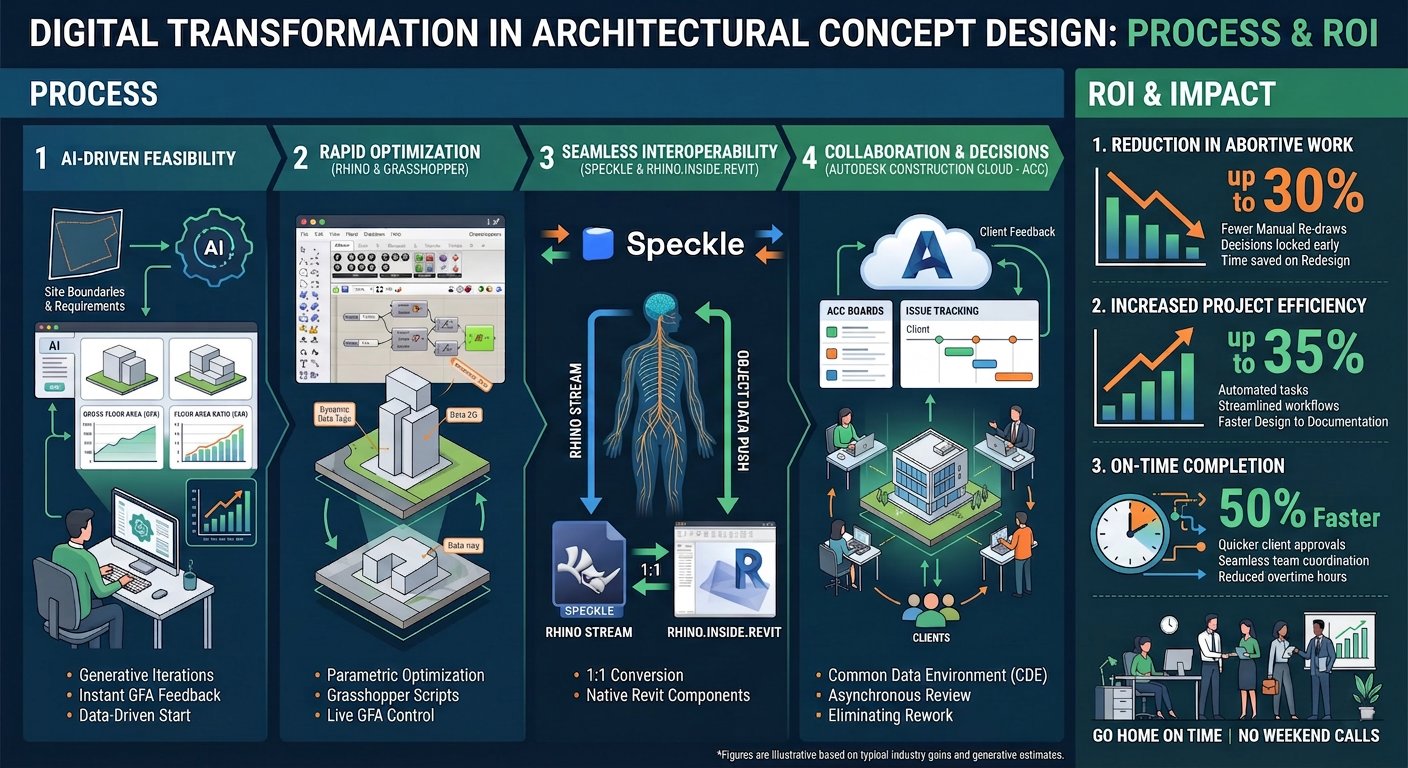
1. The Death of the “we need three options”
The workflow no longer begins with a single line in a a 3D or CAD program. Instead, it starts with Generative AI. By inputting site constraints and program requirements, we are able to generate dozens of massing iterations in minutes.
These AI models provide instant feedback on Gross Floor Area (GFA) and Floor Area Ratio (FAR) before a single 3D element is manually modeled. This phase eliminates the “guesstimate” of early feasibility, ensuring the design is aligned with program from minute one. You get to design and visualize ideas in minutes and streamline client selection.
2. The Design-Documentation Bridge
Once a conceptual direction is set, the geometry moves into 3D Design software (Rhino). Here, the focus is on “Design Surgery”—rapidly refining forms while Grasshopper scripts maintain a live link to GFA and area control. Surprisingly, or not, there are many Generative AI tools that are able to do same process without need for any modeling software. It means, you again get to design and visualize selected design optimizations in minutes.
The historical “wall” between Rhino (design) and Revit (documentation) has been dismantled by Rhino.Inside.Revit and Speckle. And yes, Rhino and similar tools are Design tools, Revit is a documentation tool, therefore timely using of either is crucial for an efficient workflow.
- Speckle acts as the digital nervous system, allowing designers to “push” specific object data to a web-based stream.
- Rhino.Inside.Revit allows for a 1:1 translation of complex conceptual geometry into native, schedulable Revit components.
- (no endorsements intended for any)
3. The Common Data Environment
The true evolution lies in how we communicate.
Traditionally, design decisions were lost in email chains or static PDF markups. Today, Autodesk Construction Cloud (ACC) serves as the “Single Source of Truth. (Unless Aconex is in the room)”
By using ACC Boards and Issue Tracking, stakeholders and clients can interact with the live model. A client can flag a design alteration in a web browser; that flag is immediately visible to the architect in Revit. This real-time loop eliminates abortive work, the soul crushing process of redrawing elements because a decision wasn’t communicated in time. Look at it as, you get to go home on time, and no weekend calls.
4. Measuring the Impact: Efficiency by the Numbers
Transitioning to this type of workflow isn’t just about better visuals; it’s about a measurable ROI on human capital. While the specific ROI percentages vary by project, the reduction in overtime hours is immediately visible.
| Metric | Traditional Wf. | Intelligent Wf. |
| Data Integrity | High risk of “broken links” & manual re-entry | Single Source of Truth (ACC/Speckle) |
| GFA Accuracy | Periodic checks (prone to human error) | Real-time parametric validation |
| Client Feedback | Lag time via email and PDF markups | Instant via ACC Boards / Live Streams |
| Labor Cost | High % of “Abortive Work” (Redrawing) | Focused on “Design Precision” & refinement |
| Delivery | Manual “catch-up” between tools | Seamless automated live sync & notification changes |